
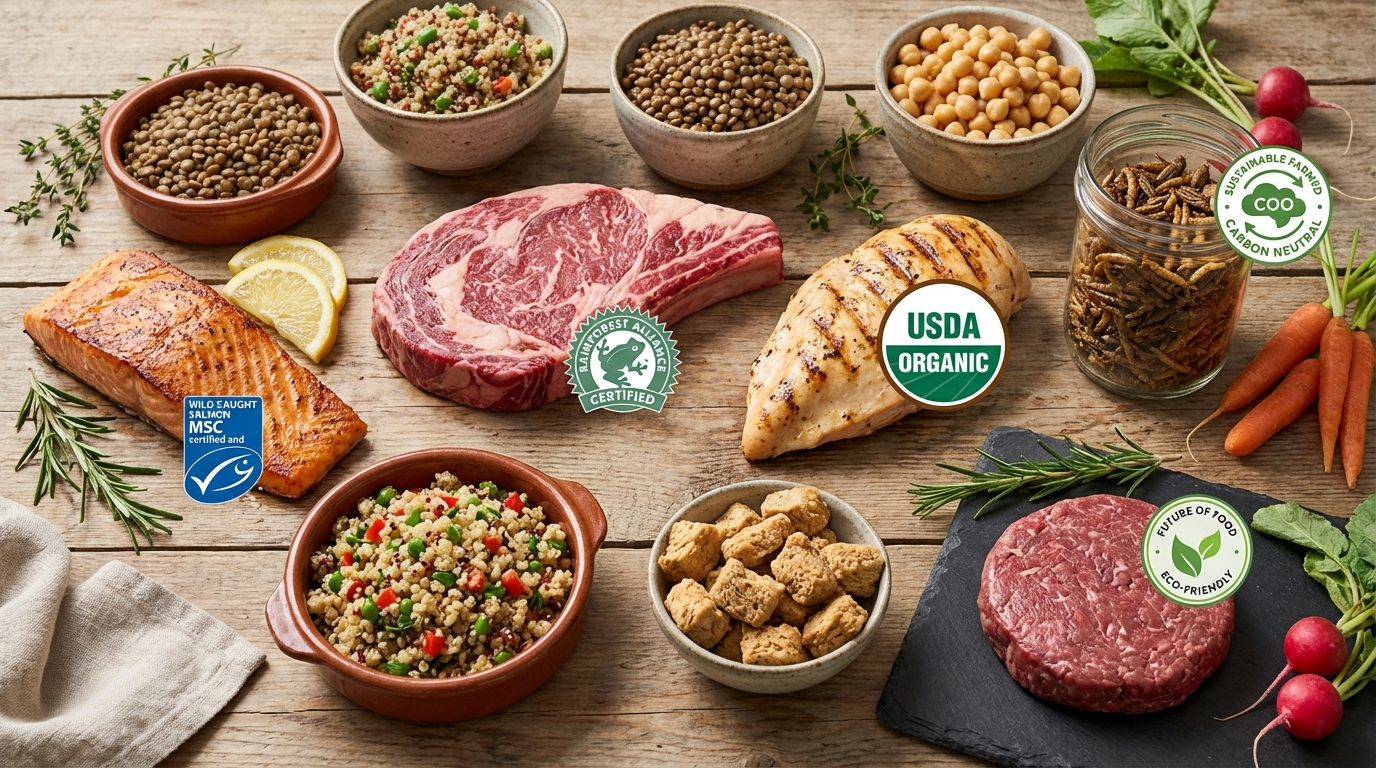

Certified sustainable proteins are reshaping how we think about food. Every time you choose a protein source, you influence farming systems, oceans, forests, and communities. That choice may seem small, yet its impact stretches far beyond your plate.
Consumers today want more than flavor and price. They want transparency. They want responsibility. They want proof that their purchases do not quietly harm the planet. That is exactly where certified sustainable proteins step in.
Rather than relying on vague claims, certification demands accountability. Independent standards verify how food is produced, sourced, and distributed. As a result, trust grows between producers and consumers.
Let’s explore why this matters and how your decisions create meaningful change.
What Certified Sustainable Proteins Really Mean
At first glance, the phrase sounds technical. However, the concept is simple. Certified sustainable proteins come from sources that meet defined environmental and ethical standards. Independent organizations verify those standards through audits and documentation.
Unlike general marketing terms, certification requires measurable compliance. Producers must demonstrate responsible land use, controlled emissions, humane animal care, and transparent supply chains. If they fail to meet criteria, certification can be revoked.
This oversight builds confidence. Instead of guessing whether a claim is genuine, you rely on third-party evaluation.
Certification does not guarantee perfection. Still, it significantly raises accountability across the food system.
Environmental Benefits of Sustainable Protein Certification
Protein production affects ecosystems worldwide. Livestock farming consumes land, water, and energy at high levels. Additionally, fishing practices can strain marine populations. Because of this, responsible management becomes essential.
Certified sustainable proteins reduce environmental pressure in several ways. Farms adopt soil protection practices. Water use is monitored carefully. Emissions are tracked and reduced when possible.
Fisheries under certification programs follow catch limits. They also protect breeding grounds. These measures maintain marine balance over time.
Moreover, habitat destruction decreases when sustainable guidelines are followed. Forest clearing for grazing or feed crops is limited under many certification frameworks.
When ecosystems remain intact, biodiversity thrives. Healthy ecosystems, in turn, support long-term food production.
Protecting Forests and Oceans Through Certification
Forests act as carbon sinks. They regulate climate and shelter wildlife. However, deforestation often occurs to expand agricultural land.
Certification programs frequently require zero-deforestation commitments. Farmers must prove that land conversion does not threaten protected areas. This approach preserves wildlife corridors and natural habitats.
Oceans face similar pressure. Overfishing disrupts marine ecosystems rapidly. Certified fisheries set quotas based on scientific research. They monitor species populations and restrict harmful gear.
Without oversight, resources can be depleted quickly. Responsible certification encourages long-term thinking instead of short-term gain.
As demand for certified sustainable proteins grows, pressure on fragile ecosystems decreases.
Ethical Standards and Animal Welfare in Sustainable Proteins
Ethics matter just as much as environmental impact. Consumers increasingly care about how animals are treated during production.
Certification programs often include humane handling standards. Animals must receive proper nutrition, shelter, and veterinary care. In many systems, overcrowding is restricted.
Improved welfare practices reduce stress and improve overall herd health. Although certification cannot eliminate every challenge, it establishes baseline protections.
Supporting verified products signals that ethical treatment remains important.
Transparency and Traceability Across the Supply Chain
Modern supply chains span continents. Ingredients may change hands multiple times before reaching consumers. Therefore, traceability becomes essential.
Certified sustainable proteins require detailed documentation. Producers record sourcing, processing, and distribution steps. Auditors verify these records regularly.
If a problem emerges, companies can trace it quickly. Rapid response limits damage and protects public trust.
Clear traceability reduces uncertainty. Consumers gain insight into where their food originates and how it was handled.
Health Considerations Linked to Responsible Protein Choices
While sustainability focuses on ecosystems, health remains a priority.
Many certification standards restrict harmful chemicals and irresponsible antibiotic use. Feed quality often undergoes stricter monitoring. As a result, contamination risks may decrease.
Balanced nutrition still depends on overall dietary habits. However, certified sustainable proteins can align environmental responsibility with personal wellness goals.
Choosing responsibly produced options encourages safer farming systems.
Economic Impact of Sustainable Certification
Sustainability also influences livelihoods.
Certification programs frequently support fair labor conditions. Workers gain safer environments and clearer standards. Small-scale farmers sometimes benefit from access to premium markets.
Although certification involves costs, long-term stability improves when ethical systems are implemented.
Communities strengthen when supply chains operate responsibly.
Challenges Facing Certified Sustainable Proteins
Despite progress, obstacles remain.
Certification fees can burden smaller producers. Complex paperwork may discourage participation. Additionally, consumers often struggle to distinguish credible labels from weak claims.
Greenwashing sometimes confuses buyers. Companies may use language that sounds sustainable without proper verification.
Education solves much of this confusion. Researching certification bodies helps identify trustworthy standards.
Although no system is flawless, independent verification still raises overall accountability.
Climate Change and Sustainable Protein Production
Food production plays a role in climate change. Livestock generates methane. Fertilizers release nitrous oxide. Transportation adds carbon emissions.
Certification programs address these concerns by encouraging emission tracking and reduction strategies. Some farms adopt regenerative agriculture practices. Others integrate renewable energy into operations.
Progress may be gradual, yet incremental reductions matter.
When consumer demand shifts toward certified sustainable proteins, producers adapt to remain competitive.
Comparing Certified and Non-Certified Protein Sources
Not every non-certified product is harmful. However, certified options provide verified standards.
Without independent review, companies rely on self-reporting. With certification, audits confirm compliance.
Accountability increases when oversight exists. Transparency strengthens trust.
Although certification adds complexity, it reduces uncertainty.
How to Identify Trustworthy Certification Labels
Look beyond packaging claims. Research the certifying organization. Reputable programs publish clear criteria and require regular audits.
Check whether standards include environmental protection, labor conditions, and traceability.
Avoid vague language without third-party backing. Genuine certification logos link to public databases or official websites.
Informed choices empower consumers.
Consumer Influence on Sustainable Protein Markets
Consumer demand drives change faster than regulations alone.
When shoppers prioritize verified products, retailers adjust inventory. Suppliers strengthen sourcing standards. Farmers adapt practices.
Each purchase becomes a signal. Collectively, those signals reshape industries.
Supporting certified sustainable proteins encourages long-term accountability.
The Future of Certified Sustainable Proteins
Certification systems continue to evolve. Technology improves monitoring. Blockchain enhances traceability. Data analysis strengthens verification.
Alternative proteins, including plant-based and cultivated options, are entering certification frameworks as well.
Over time, responsible production may become the baseline expectation.
As awareness expands, transparency will likely increase across global food systems.
Conclusion
Certified sustainable proteins matter because they connect everyday choices with global responsibility. They reduce environmental strain, protect forests and oceans, and improve supply chain transparency. Ethical labor practices and humane animal care are reinforced through independent verification.
Although certification cannot solve every challenge, it raises standards significantly. By choosing responsibly verified protein sources, consumers support ecosystems, communities, and long-term food security.
Every purchase carries influence. When you prioritize accountability, you help shape a more sustainable future for everyone.
FAQs
- What are certified sustainable proteins?
They are protein sources verified by independent organizations to meet environmental, ethical, and traceability standards. - Are certified sustainable proteins healthier?
They may reduce exposure to harmful practices, but overall health depends on balanced nutrition. - Do certification labels guarantee zero environmental impact?
No system eliminates impact entirely, but certification significantly reduces harm through monitored standards. - How can I verify a certification logo?
Visit the certifying organization’s official website to review standards and confirm authenticity. - Why should consumers prioritize certified options?
Choosing verified products encourages responsible production and strengthens accountability across supply chains.