

A practical guide for dog owners starting to notice how much daily pet waste they create — and looking for simple, realistic ways to reduce it.
| Every dog owner using standard disposable poop bags, pee pads, and diapers adds up to 1,000+ single-use plastic items to landfill every year — per dog. None of it breaks down in your lifetime. The swaps are easier than you think, and you don’t have to do everything at once. |
Key Takeaways
- Over 415 billion plastic poop bags are thrown away globally every year — more than 1.1 million tons of plastic[1]
- A dog using 2 pee pads a day generates 730 disposable pads per year, all going to landfill where they take 500+ years to break down[3]
- ‘Biodegradable’ on pet products is a marketing term with no legal standard — it means almost nothing without certification[6]
- Reusable pee pads, washable diapers, and certified-compostable poop bags are low-effort swaps that cut waste significantly
- One swap saves hundreds of items per year. Progress beats perfection.
How Much Waste Is Your Dog Actually Creating?
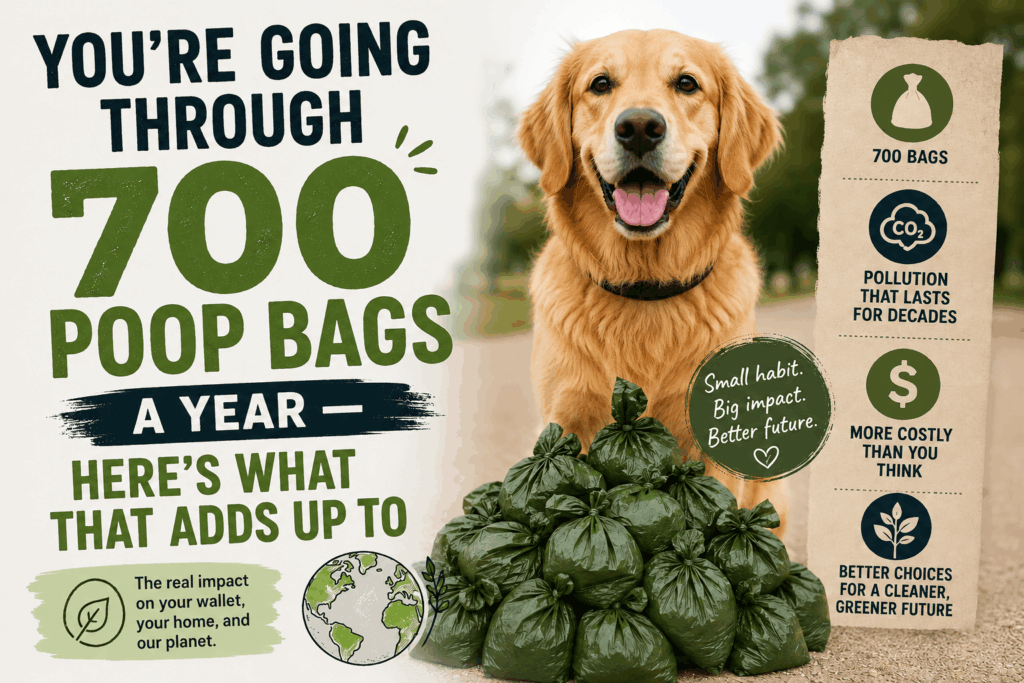
Most dog owners never add it up. But the numbers are hard to ignore once you do:
| Product | Annual Total | Breaks Down In |
|---|---|---|
| Plastic poop bags | 365–730 bags | 400–1,000 years |
| Disposable pee pads | 365–1,095 pads | 300–500 years |
| Disposable dog diapers | Hundreds/year when in use | 300–500 years |
| Disposable grooming wipes | 365–1,000+ wipes | 80–200 years |
That’s a conservative 1,000–3,000 single-use plastic items per dog, per year. Over a 10-year dog’s life, one household can send 10,000–30,000 pieces of plastic to landfill. For more on the pet industry’s plastic problem, the scale is even bigger than most people realise.
The Poop Bag Problem
Standard poop bags are made from LDPE or HDPE plastic — the same family as grocery bags — and cannot be recycled once used. A peer-reviewed study in Environmental Pollution estimated 415 billion plastic poop bags are disposed of globally every year, equivalent to 0.76–1.23 million tons of plastic waste.[1] In the US alone, producing those bags consumes an estimated 150 million gallons of crude oil annually.[2]
‘Biodegradable’ bags: the label that means almost nothing
The word ‘biodegradable’ has no legal definition for pet products. Some bags marketed this way are conventional plastic with an additive that breaks them into microplastic fragments faster — which is actually worse.[6] The label to look for is ‘compostable’ with a third-party certification:
| Label | What It Actually Means |
|---|---|
| ‘Biodegradable’ / ‘Eco-friendly’ | No legal standard. Can still be conventional plastic. ❌ Ignore it. |
| BPI Certified Compostable | Meets ASTM D6400 for industrial composting. ✅ Legitimate. |
| TUV Austria OK compost HOME | Certified to compost at home — no industrial facility needed. ✅ Best option. |
Even certified compostable bags only fully break down in the right composting conditions — not in a standard landfill.[6] The best pairing: a TUV HOME-certified bag plus a dedicated dog waste composter. Our guide on how to compost dog waste safely at home walks you through it. For a full review of brands that meet the standard, see our eco-friendly dog waste bags guide.
The Pee Pad Problem
A standard disposable pee pad is a multi-layer plastic product: non-woven synthetic fibre on top, wood pulp in the middle, superabsorbent polymer (SAP) gel, and a polyethylene plastic film base.[4] Because these layers are bonded and contaminated with waste, they can’t be recycled. A dog using just two pads a day sends 730 pads to landfill annually — and each one takes 300–500 years to break down.[3]
Making the switch to reusable pads
The biggest concern people have is cleaning effort. In practice, it’s minimal — shake off solids, rinse, machine wash. The real difference is in the numbers:
| Disposable Pad | Washable/Reusable Pad | |
|---|---|---|
| Annual cost (2 pads/day) | $150–$290 | ~$30–60/year after payback |
| Annual waste | 700+ pads to landfill | Near zero |
| Absorbency | Good for light use | Equal or better — some hold 8–10x their weight |
| Transition time | None | 1–2 weeks for most dogs to adapt |
Tip: during the transition, lay a used disposable pad on top of the washable one — the familiar scent guides your dog to use the same spot. For other plastic-free dog products for eco pet owners, our shopping guide has you covered.
The Dog Diaper Problem
Dog diapers are used for dogs in heat, post-surgery recovery, senior incontinence, and puppy training gaps. The global dog diapers market was valued at $338.4 million in 2024 and growing at 8.2% annually[5] — driven almost entirely by disposables that, like pee pads, won’t decompose for centuries.
Washable dog diapers have improved dramatically and are now widely available. The math is straightforward: 3–5 washable diapers bought once eliminate dozens of disposables per heat cycle, and hundreds per year for senior dogs with ongoing incontinence. The routine is the same — just launder after use instead of binning.
| When disposable is still the right call Post-surgical recovery (sterility is critical — ask your vet), travel where laundry isn’t available, or dogs that destroy washable versions. For those situations, look for chlorine-free, fragrance-free options with plant-based materials — meaningfully better for your dog’s skin even if not truly eco-friendly. |
Three More Daily Disposables Worth Reconsidering
Grooming wipes
Most disposable wipes are made from non-woven polyester — synthetic, non-biodegradable, and easily replaced by a washable microfiber cloth or cut-up old towel. If you prefer disposable, look for 100% bamboo non-woven fabric with a compostable certification. Our eco friendly dog grooming products guide covers natural alternatives in detail.
Dog food packaging
Multi-layer plastic pet food pouches are not recyclable through standard programs.[8] Switching to metal cans (recyclable) or bulk dry food reduces this significantly. Our breakdown of recyclable dog food packaging explains what packaging claims actually mean, and our sustainable dog food brands roundup only features brands with verified commitments.
Plastic feeding bowls
Not a daily disposable, but plastic bowls develop micro-scratches that harbour bacteria over time. Swapping to stainless steel or glazed ceramic when they wear out is an easy upgrade — both are more hygienic, more durable, and recyclable at end of life. Browse plastic-free dog products online for options.
Your Simple 3-Step Swap Plan
| Start here — not everywhereStep 1 — Use up what you have. Don’t bin products you’ve already paid for. Switch when you reorder.Step 2 — Swap one product at a time. Most dog owners go through poop bags fastest. Try a pack of BPI- or TUV-certified compostable bags first.Step 3 — Add one more swap every month or two. Washable pee pads next. Then a washable diaper. Small sequential changes stick. |
| Swap | Waste Impact | Ease |
|---|---|---|
| Plastic bags → BPI/TUV compostable bags | Medium | Very easy — zero behaviour change |
| Disposable pee pads → washable pads | High — 700+ items/year diverted | Moderate — 1–2 week transition |
| Disposable diapers → washable diapers | High for regular users | Easy — same routine, just launder |
| Grooming wipes → washable cloths | Low-medium | Very easy — free if using old towels |
| Plastic bowls → stainless steel | Low immediate | Easy — replace when worn out |
Frequently Asked Questions
Do compostable poop bags break down in a regular bin?
Not meaningfully. Landfills are designed to prevent decomposition. The real benefit of certified compostable bags is that they’re made without conventional plastic, so they don’t generate microplastic fragments the same way HDPE bags do.[6] Pair them with a home dog waste composter for the best result.
Are ‘biodegradable’ bags better than regular plastic?
Marginally at best — and sometimes worse. Oxo-degradable ‘biodegradable’ bags break into microplastic fragments faster, which is a net negative.[6] Only buy bags with a BPI or TUV Austria certification seal. See our eco-friendly dog waste bags review for certified brands.
Can washable pee pads keep up with multiple accidents per day?
Yes, with enough in rotation. Aim for 3–4 so one is always clean. Premium washable pads with bamboo or microfiber cores can hold 8–10x their weight in liquid[3] — often more than disposables. They go in with your regular laundry on a warm cycle.
Is there a zero-waste option for dog waste?
The closest option: flush dog waste (not the bag) down a standard toilet. The EPA recommends this for homes connected to a municipal sewage system.[7] For outdoor collection, paper-based wraps like Pooch Paper have the lowest impact of any collection method.
More From EcoFriendlyDogProducts.com
- → Eco-Friendly Dog Waste Bags You Can Trust Today — certified compostable brand reviews
- → Compost Dog Waste Safely at Home — step-by-step home composting guide
- → Plastic-Free Dog Products Online — practical shopping guide
- → Eco Friendly Dog Grooming Products — natural alternatives for bath time
- →Recyclable Dog Food Packaging Explained — what packaging claims actually mean
- → Recycle Old Pet Gear the Safe and Responsible Way — what to do with worn-out products
- → Eco Friendly Pet Gear for Sustainable Pet Care — the bigger picture on daily pet product choices
Sources
[1] Environmental Pollution (2021) — Dog poop bags: A non-negligible source of plastic pollution → https://www.sciencedirect.com/science/article/abs/pii/S0269749121019370
[2] PawView (2025) — Pet Poopbag: Overlooked Environmental Truth → https://www.pawview.com/blogs/news/pet-poopbag-overlooked-environmental-truth-sustainable-selection-guide
[3] NoMoHaus (2026) — Are Reusable Dog Pee Pads Worth It? → https://www.nomohaus.com/blogs/journal/are-reusable-dog-pee-pads-worth-it
[4] DoggieLawn (2026) — The Environmental Benefits of Biodegradable Potty Grass Pads → https://doggielawn.com/blogs/blog/the-environmental-benefits-of-biodegradable-potty-grass-pads
[5] MetaTech Insights (2024) — Dog Diapers Market Share & Size 2025–2035 → https://www.metatechinsights.com/industry-insights/dog-diapers-market-1635
[6] Time Magazine (2026) — Compostable Dog Poop Bags Aren’t Really That Compostable → https://time.com/6328300/how-compostable-are-dog-poop-bags/
[7] US Environmental Protection Agency — Pet Waste and Water Quality → https://www.epa.gov/npdes/animal-waste-what-you-should-know
[8] AKC (2026) — Dog Poop Disposal: The Importance of Cleaning Up After Your Dog → https://www.akc.org/expert-advice/advice/dog-poop-cleanup/
| Last Updated: June 2026. Updated periodically as certification standards and market data change. |