
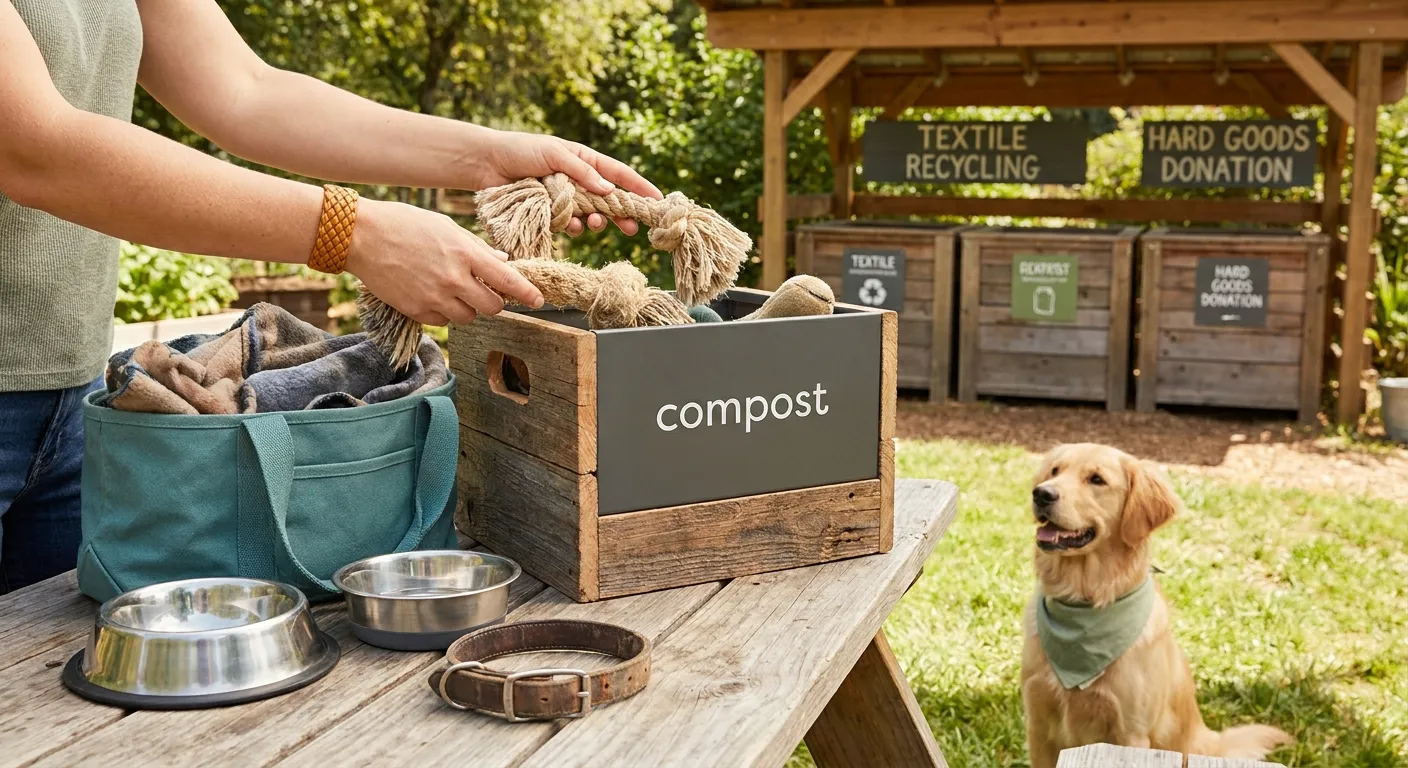

Responsible dog product disposal begins before you choose a bin. A serviceable item may have a useful second home; a damaged restraint item may not. A bed with mixed materials may need a different route from a plain package, and a battery-powered accessory needs its own check. Sort by condition and actual components rather than treating every old dog item as one waste category.
This guide provides a practical sorting workflow without claiming that every product can be recycled, donated or composted. It is general information, not veterinary advice. Consult your veterinarian about contamination or health concerns and your local waste service about accepted routes. No universal collection rule or quantified environmental saving is asserted.
Create a small inventory before clearing the cupboard
List each item and why it is no longer used: wrong size, duplicate, worn, damaged or unsuitable. Record what you know about its materials and whether it contains a battery or electronics. Keep unknown components marked unknown. A general description such as eco material is not enough to decide the disposal route.
Separate items you might keep from items you intend to remove. Do not use the exercise to justify buying replacements without a defined need. Likewise, do not retain an unreliable product because discarding it feels wasteful. The inventory should help you make a practical decision about each item rather than move a mixed pile from one storage area to another.
Check whether continued use is appropriate
Inspect the product under the manufacturer’s instructions. For equipment used to manage the dog, pay attention to fasteners, attachment points and damage. Do not assume a homemade repair restores the original function or rating. Ask the manufacturer or an appropriately qualified professional about repair options when reliability matters.
An owner storage pouch with a replaceable closure presents a different task from a damaged leash or harness. Keep those roles separate. A product no longer suitable for the dog should not be passed to someone else as reliable gear. Continued use is useful only when the item remains appropriate for its intended job.
Consider repair within clear limits
Ask whether a component can be replaced through an authorized route and whether instructions are available. Compare the practical repair with the item’s remaining suitability. Do not dismantle sealed electrical equipment or alter load-bearing gear simply because reuse is an attractive goal. Uncertainty about safe repair should remain visible.
For low-impact owner accessories, a modest repair within your skills may restore an organizer or washable cover. Inspect the result and use it only for the defined task. This guide does not provide a technical repair method or certify the finished item. The decision should be based on actual condition, manufacturer guidance and the consequences of failure.
Ask before donating
Contact a shelter, rescue, community group or individual recipient about the exact item, condition and cleaning requirements. Do not assume every organization accepts used beds, toys, food or equipment. A recipient may have practical restrictions you cannot infer from its general mission. Obtain acceptance before making a delivery.
Describe damage honestly and do not donate a product whose reliability is doubtful for its essential use. Follow the recipient’s preparation instructions rather than claiming a home-cleaning routine makes every item acceptable. Donation should give the recipient something it can actually use, not transfer your sorting and disposal problem to another person.
Keep product information with a useful handover
For an accepted serviceable item, include relevant model, sizing and use instructions if available. Remove personal account information where appropriate without losing the information the recipient needs to use the product. For connected devices, follow the manufacturer’s account and data-removal instructions before transfer.
A handover should make the item’s limits clear. If you do not know its model or history, say so. Avoid describing it as safe for every dog or suitable for a particular health problem without evidence. The recipient can then decide how it fits its own circumstances and whether additional assessment is needed.
Identify recycling by the exact item
Check the local service’s accepted-item list or ask about the product directly. A bed can include fabric, foam, zippers and other components. A toy can combine materials that a general curbside stream does not accept together. Record the service’s answer for the whole item rather than using one visible material as the basis for disposal.
The FTC’s Green Guides summary explains the need for specific recycling and environmental claims. Apply the same care when reading a label: recyclable does not automatically mean accepted by the route available to you. This article does not promise a destination for mixed-material products. Verify local acceptance before placing an item in a recycling stream.
Separate batteries and electronics
Look for product markings and manufacturer information identifying a battery. Do not infer its chemistry from shape alone, and do not remove a battery that is not intended to be user-serviceable. A tracker, light or automated accessory can need a different route from a passive fabric item. Check the complete device as well as any removable battery.
The EPA’s household-battery guidance explains that lithium batteries should not be placed in ordinary household garbage or curbside recycling. Follow the relevant handling and collection guidance and contact the manufacturer or local collection program when unsure. If a battery is damaged, seek specific instructions rather than improvising a dismantling or storage procedure.
Treat material claims as questions
If an item is called biodegradable or compostable, ask which component, process and conditions the claim covers. Check whether the actual receiving facility accepts the item. A material description does not create a local service or prove that an entire product, with fasteners and coatings, can go into a particular stream.
Do not assume that plant-derived means harmless in any disposal setting. Keep the label’s scope and the facility’s instructions together. For pet-waste-related products, also ask about the waste contents, not only the container. A route suitable for a clean package may be unsuitable for a used bag or contaminated item.
Handle health-related contamination with advice
If a product was used during illness or has contamination you are concerned about, ask your veterinarian and the waste service how to manage it. Do not prescribe a chemical mixture or claim that a home treatment makes it safe to donate. Follow product and professional instructions applicable to the situation.
Keep such items separate while obtaining guidance in a way consistent with that guidance and away from access by pets or children. The purpose is to avoid making an uncertain health claim during an otherwise ordinary clearing task. This article does not diagnose contamination or provide a disinfection protocol.
Work through four concrete examples
For a serviceable bowl no longer needed, ask a recipient whether it accepts that exact type and condition. For a worn bed, identify components and ask the local program about whole-item or component routes. Do not assume either can enter a general recycling bin based on appearance alone.
For a damaged leash, investigate manufacturer guidance and avoid passing it on as dependable restraint equipment. For a battery-powered tracker, use the device and battery collection guidance rather than sorting it with ordinary plastic products. Each example has a different first question. A single rule such as donate everything or recycle all plastics would miss those distinctions.
Close the loop with a simple record
Mark each item with its decided route, the source of the instructions and any appointment or preparation needed. Keep unverified routes unresolved until you have an answer. Do not leave a donation or specialist-collection pile indefinitely where it creates clutter or remains accessible to the dog. Choose a practical next action consistent with the instructions.
Responsible dog product disposal is a sequence of checks: condition, useful recipient, components and accepted destination. Reuse or repair can be considered where appropriate, and specialist handling matters for some items. The goal is a clear, completed route for the actual product, with claims limited to what you can verify. That is more useful than a broad promise that every old item can have a green ending.